Agentic commerce has been moving from theory to reality for a while now.
AI systems are no longer just helping people research products, they’re starting to complete parts of the journey on their behalf.
What Google has announced with the Universal Commerce Protocol (UCP) isn’t a sudden change in direction.
It’s the infrastructure finally catching up with where commerce behaviour was already heading.
UCP formalises how AI systems interact with retailers across the entire shopping journey. From discovery and decision making through to checkout and post-purchase support, using a shared, open standard.
What Is the Universal Commerce Protocol (UCP)?
At a high level, UCP is a common language for agentic commerce.
Rather than retailers building one-off integrations for every AI system or shopping agent, UCP allows agents and commerce platforms to communicate in a consistent, standardised way.
Google describes UCP as:
- Open and not tied to one specific system
- Built with major retailers and platforms including Shopify, Etsy, Wayfair, Target and Walmart
- Compatible with existing protocols such as Agent2Agent, Agent Payments Protocol (AP2) and Model Context Protocol (MCP)
- Designed to work across verticals, not just retail
Importantly, retailers remain the merchant of record, keeping ownership of the customer relationship even when purchases happen inside AI-driven experiences.
Video credit: Google
Why Google Is Introducing UCP Now?
From Google’s perspective, the problem isn’t discovery, it’s decision-making.
As AI takes on more responsibility in shopping journeys, those systems need:
- Reliable product data
- Accurate availability and pricing
- Clear rules around checkout and post purchase support
Without a shared protocol, every integration becomes bespoke, fragile, and difficult to scale.
UCP is Google’s attempt to solve that at a global level.
What UCP Enables (Starting With Checkout)
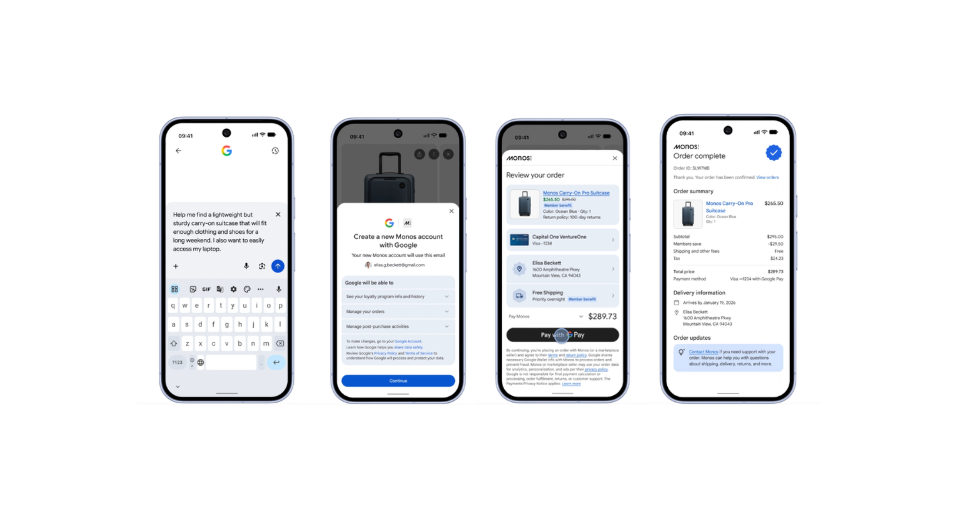
The first major implementation of UCP is native checkout inside Google’s AI surfaces, including:
- AI Mode in Search
- The Gemini app
For eligible U.S. retailers (with wider roll-out on the horizon), this means shoppers can:
- Discover products
- Check pricing, availability and variants
- Apply loyalty offers or personalised pricing
- Complete checkout via Google Pay
- All without leaving the conversation
Throughout the process, the retailer still fulfils the order and owns the customer relationship.
This is agentic checkout becoming operational, not theoretical.
This Isn’t Just About Google
UCP sits within a wider pattern across platforms.
AI is increasingly becoming the interface, not just the assistant.
Across the ecosystem we’re seeing:
- Google AI Mode handling discovery, comparison and checkout
- Chat based product discovery and purchasing in AI environments
- Amazon’s conversational shopping assistants
- Shopify building AI tools that support both operations and sales
- Meta testing commerce flows inside chat experiences
Different platforms, same direction: fewer visible steps between intent and purchase.
What UCP Means for Ecommerce Teams
For ecommerce teams, the implications are structural, not tactical.
This isn’t about “optimising for a new feature”.
It’s about preparing your systems for machine-led decision making.
What starts to matter more:
Product & Inventory Accuracy
AI relies on data feeds, not just page content.
Inconsistent pricing, outdated availability, or incorrect variants will surface quickly, and trust may be reduced.
Structured Data & Schema
Clear, consistent schema helps AI systems understand products, offers, reviews and eligibility.
This becomes foundational, not optional.
Consistency Across Systems
Product feeds, CMS data, Merchant Center, inventory systems and on-site content need to align.
Conflicting signals create friction for AI decision-making.
Brand & Trust Signals
As journeys compress, brands need to earn trust earlier, and reinforce it after purchase.
Websites still matter, but their role shifts before and after the transaction.
Websites Aren’t Disappearing – Their Role Is Changing
UCP doesn’t remove websites from commerce.
Instead, it changes when and how users interact with them.
Some journeys may never touch a product page.
Others may rely on AI summaries, comparisons or checkout flows.
That creates new pressure, but also new opportunity.
The brands that adapt best will focus on:
- Earning trust before the click
- Building loyalty after the purchase
- Supplying AI systems with data they can rely on confidently
How This Connects to Agentic Commerce
If this feels familiar, it should.
UCP is the formal protocol behind the shift I’ve previously written about in agentic commerce, where AI doesn’t just recommend products but actively completes parts of the journey.
Agentic commerce explains the behavioural shift.
UCP explains the technical framework enabling it.
Together, they signal a future where:
- The funnel doesn’t disappear
- It becomes less visible
- And the inputs behind AI decisions become more important than ever
The key question for brands is no longer just: “How do we drive more clicks?”
It’s becoming: “How do we stay relevant and trusted when the journey is increasingly invisible?”
UCP doesn’t answer that on its own, but it makes the direction unmistakably clear.
If you’d like support reviewing your product data, structured markup, or ecommerce setup in light of these changes, let’s talk.