Short answer: no, you cannot rank in an LLM, not in the way you rank in Google, Bing and other Search Engines.
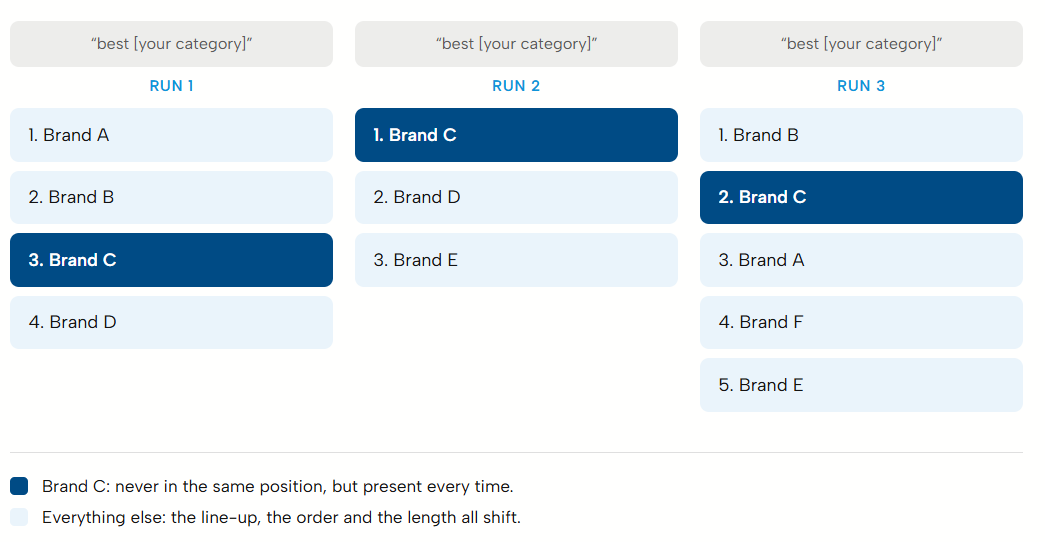
There is no fixed position to hold. Ask ChatGPT the same question ten times and you’ll get ten different answers, in a different order, sometimes with a different number of brands entirely. Nothing is stable. So if a tool is telling you you’re “position 1 in ChatGPT,” that isn’t a ranking. It’s one sample from a system designed to vary.
This is not just my opinion, there’s now solid data behind it.
The Research
SparkToro and Gumshoe.ai set out to answer a simple question: are AI recommendations consistent enough to be tracked at all?
Rand Fishkin and Patrick O’Donnell had 600 volunteers run 12 different prompts through ChatGPT, Claude and Google’s AI a combined 2,961 times. Real people, real prompts, run over and over, across categories from chef’s knives and headphones to cancer care hospitals and digital marketing consultants. Each prompt was run 60 to 100 times per platform.
Here’s what came back:
- Less than a 1 in 100 chance of getting the same list of brands twice.
- Roughly 1 in 1,000 odds of getting that list in the same order.
- The number of items in the list changed too, sometimes two or three, sometimes more than ten.
Fishkin’s verdict on the tools selling “AI rank tracking” was blunt: any tool giving you a “ranking position in AI” is, in his words, full of baloney.
Why This Happens
This isn’t a bug, and it isn’t going to get “fixed” in a future model release. It’s how the technology works.
Search engines are built to return a ranked, repeatable set of results. Ask Google the same question twice and you’ll broadly get the same thing. That stability is the whole basis of rank tracking.
LLMs aren’t built that way. They’re probability engines. They generate a likely response, not the response, and they’re designed to produce varied output rather than identical lists. Different sampling, different context, different phrasing from the user, all of it shifts what comes out. Two people asking the same thing, or the same person asking twice, can get entirely different answers.
So there is no “position 1” to win. There is no stable list to climb. The list doesn’t exist until the moment it’s generated, and it’s rebuilt, differently, every single time.
Ask an AI tool the same question three times and you get three different answers. Different brands, different order, different list length.
But Don’t Just Stop Aiming for AI Visibility
If you stop there, you’d conclude AI visibility is unmeasurable and there’s nothing to be done, and that’s not the finding.
Across hundreds of runs, a real signal does emerge. Some brands appear far, far more often than others. One agency in the study showed up in 85 out of 95 responses to the same prompt. Not ranked first, just present… consistently.
And there’s a second finding that makes this even clearer. In a follow up, 142 people were asked to write their own prompt for the same underlying need. The prompts were wildly different from each other, semantically about as similar as Kung Pao chicken and peanut butter. And yet the same brands kept surfacing regardless of how the question was phrased.
That’s the whole game. However someone asks, whatever wording they use, whatever run of the model they land on, a certain set of brands keeps showing up. That set is what you’re competing for.
You Don’t Rank. You Get Into the Set.
The metric isn’t position. It’s presence, how often you appear across many runs and many phrasings.
And you can’t hack your way in. You build it the slow way: by being cited, mentioned, reviewed and associated with your category across the web, over and over, until the models have learned that you belong in that set.
That means the things that have always mattered, still matter:
- Technical foundations. An LLM can’t recommend a site it can’t crawl, parse or understand. If your content isn’t in the raw HTML, most AI crawlers won’t see it at all.
- Genuine expertise and trust. The models draw on the sources that discuss your category. If you’re absent from those sources, you’re absent from the set.
- Being talked about off your own site. Mentions, coverage, reviews, communities. You cannot get into the consideration set purely from inside your own website.
- Content people actually reference. Not thin AI filler produced at volume, the stuff that gets cited.
None of that is new. That’s SEO, done properly, with an understanding of how the newer surfaces consume it.
About the “AEO Experts”
You’ll have seen the terms. AEO, GEO, LEO, whatever gets coined next. Some of the thinking behind them is fine. A lot of it is a rebrand of things SEOs have done for twenty years, sold at a premium with a new acronym.
The genuinely dangerous ones are those selling a “ranking position.” Because now we know what that number actually is. A snapshot of a probabilistic output that will be different the next time it runs. Sell someone a rank they can’t hold and can’t verify, and you can show them a “win” any time you like. Just run the prompt until you get a nice looking answer.
If anyone tells you they’ll make you rank number one in AI, please avoid.
The Honest Discussion Around Visibility in LLMS
You don’t rank in an LLM. You earn your way into the set it pulls from.
There’s no shortcut to being the answer, and no hack that games a list which reorders itself every single time. There’s just the unglamorous, compounding work of being genuinely visible, credible, crawlable and talked about, until the models can’t help but include you.
Which is, as it turns out, exactly what good SEO has always been.
If you want help building visibility that holds up in both search and AI results, that’s the work I do. Explore SEO audits or get in touch, and we’ll look at where your gaps actually are.
Frequently Asked Questions
Can you rank in an LLM?
No, not in the way you rank in a search engine. LLMs don’t hold a fixed, repeatable list of results. Research from SparkToro and Gumshoe.ai found that asking the same prompt repeatedly gives you less than a 1 in 100 chance of the same list of brands, and roughly 1 in 1,000 odds of the same list in the same order. There is no stable position to occupy, so there is nothing to rank for in the traditional sense.
Why do AI answers change every time I ask the same question?
Because LLMs are probabilistic. They’re designed to generate a likely answer rather than a single fixed one, so the output varies between runs. The list of brands, the order and even how many are included can all change from one response to the next, even for the identical prompt from the same user.
So can AI visibility be measured at all?
Yes, but as presence, not position. Across many runs, some brands appear far more often than others. That frequency of appearance is a real, measurable signal. Any tool reporting a fixed “ranking position in AI” is measuring noise; tools measuring how often you appear across many runs are measuring something meaningful.
How do I get my brand to appear in AI answers?
By earning your way into the set the model draws from. That means solid technical foundations so crawlers can actually read your site, genuine expertise and trust signals, being mentioned and cited across the wider web, and content worth referencing. It’s a long game, not a switch you flip.
Is AEO or GEO different from SEO?
Not as different as the marketing suggests. AI visibility sits on top of good SEO, it draws on the same crawlable, well-structured, trustworthy content. There’s no separate set of tricks that bypasses the fundamentals. Be wary of anyone selling AI “rankings” as a distinct service.
Should I pay for an AI rank tracking tool?
Be careful. If a tool reports a fixed ranking position in ChatGPT or any other LLM, that number isn’t stable and can’t be, as the research shows. Tools that measure how frequently your brand appears across many runs of many prompt variations are far more useful than anything claiming to show you a position