
We’ve all seen the offer: “Leave us a 5 star review and get 10% off your next order.” It’s tempting, especially when you’re trying to build visibility. But incentivising reviews breaks Google’s guidelines, and it can do more harm than good.
Here’s why it’s a problem, why reviews matter so much for local visibility in the first place, and the legitimate ways to earn a steady stream of genuine feedback.
Why Reviews Matter More Than Most Businesses Realise
Reviews aren’t just social proof sitting on your profile. For a local business, they’re one of the most direct influences on how visible you are.
Google has confirmed that review signals, the quantity, quality, recency and even the words used in them, are a factor in local rankings. They feed into whether you appear in the local map pack, how you’re positioned against nearby competitors, and increasingly how you’re represented in AI-generated and voice results, where a business’s reputation is summarised rather than listed.
In other words, reviews don’t just help someone decide once they’ve found you. They help decide whether you’re found at all. That’s exactly why they’re a core part of any local SEO strategy, and exactly why it’s worth getting them the right way.
Why You Shouldn’t Incentivise Reviews
Google’s stance is clear: offering anything in exchange for a review, a discount, a freebie, entry into a prize draw, any kind of reward, is against its policies. This applies whether you’re rewarding all reviews or only the positive ones.
There are good reasons for the rule, and good reasons to follow it beyond just compliance.
Incentivised reviews attract the wrong feedback. People reviewing for a discount are reviewing the discount, not your service. You get vaguer, less useful reviews that don’t actually reflect the experience.
They erode trust. Customers are increasingly good at spotting reviews that feel bought. A wall of suspiciously glowing five stars can do more damage to credibility than a smaller number of honest ones.
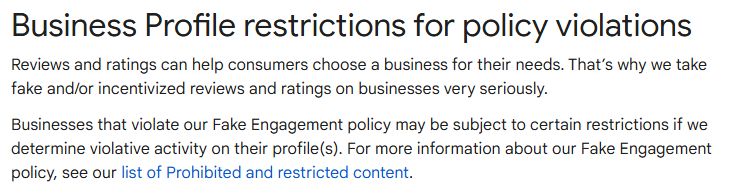
They put your profile at risk. Google can and does remove reviews it identifies as incentivised, and repeated violations can affect your wider profile. You could lose the very reviews you paid to get.
The short version: incentivised reviews are a shortcut that tends to cost more than it returns.
Fine to do
- Ask happy customers, politely, at the right moment
- Send a direct review link to make it easy
- Add review prompts to emails, invoices and QR codes
- Respond to every review, good or bad
- Follow up to check how a customer is getting on
Against Google’s rules
- Offering a discount for a review
- Giving freebies or gifts in return
- Prize-draw entry for leaving feedback
- Rewarding only the positive reviews
- Any incentive at all, even for honest reviews
How to Get Your Google Review Link
One of the biggest barriers to reviews is simple friction, people mean to leave one, then forget, or can’t find where to go. The fix is to send customers a direct link that opens straight to the review box.
To find yours:
- Sign in to your Google Business Profile.
- Select the business you want reviews for.
- Look for the “Ask for reviews” or “Get more reviews” option, which generates a short link.
- Copy that link and use it everywhere it makes sense, follow-up emails, invoices, receipts, thank-you messages, or behind a QR code.
That single link removes most of the effort for the customer, and removing friction is the most reliable way to increase the number of reviews you actually receive.
Legitimate Ways to Earn More Reviews
You don’t need incentives. You need to make it easy, ask at the right moment, and genuinely deserve the feedback. Here’s what works.
Just ask, at the right time. If you don’t ask, you won’t get. The key is timing: ask when the customer is happiest, right after a successful job, a positive interaction, or a repeat purchase. A friendly, low-pressure request lands far better than a generic mass email.
Make it effortless. Use your direct review link (above) so the customer is one tap from the review box. Every extra step loses people.
Follow up. A short, warm check-in after a product or service, “how are you getting on?”, does two jobs: it shows you care, and it’s a natural moment to invite a review.
Use the channels you already have. Mention reviews in your email signature, on social media, on physical prompts like receipts, cards, or a QR-code sticker at the point of sale. Visibility plus ease equals more reviews.
Respond to every review. Reply to the good and the bad. It signals you’re engaged and that feedback is valued, which encourages others to leave theirs, and responding is itself a positive local signal.
What to Do About Negative or Fake Reviews
Negative reviews feel like a problem, but handled well they build trust. A profile with only five stars looks suspicious; a thoughtful response to a fair criticism shows you’re a real, accountable business.
For genuine negative reviews: respond calmly and professionally, acknowledge the issue, and take the detail offline where you can. You’re not really writing for the reviewer, you’re writing for every future customer reading how you handle things.
For fake or fraudulent reviews (from people who were never customers, competitors, or spam): you can report these to Google for removal against its policies. Google won’t remove a review simply for being negative, only if it breaches the guidelines, so focus your energy on the ones that genuinely break the rules and respond gracefully to the rest.
Focus on Real Connections
The goal isn’t a pile of stars. It’s honest feedback that reflects a genuinely good experience, the kind that builds trust with future customers and strengthens your visibility at the same time.
Incentives might look like a quick win, but they attract the wrong reviews, risk your profile, and undermine the trust that makes reviews valuable in the first place. Consistent, simple actions, asking at the right moment, making it easy, and responding to everyone, build something far more durable.
Reviews are one of the strongest trust signals a local business has, and they feed directly into how you show up in local search. If you’d like help building reviews into a wider local SEO strategy, get in touch and we’ll work out where the opportunities are.
Frequently Asked Questions for Google Business and gaining / managing reviews
Can I offer a discount for an honest review?
No. Google’s policies prohibit offering any incentive in exchange for a review, including discounts, freebies, or prize draw entries, even if you’re not requiring the review to be positive. Incentivised reviews can be removed and can put your profile at risk.
Do Google reviews actually affect local rankings?
Yes. Review signals, including quantity, quality, recency and relevance, are a recognised factor in local search and the map pack. A steady flow of genuine reviews supports both your visibility and your conversion.
How do I get a direct link to leave a review?
From your Google Business Profile, use the “Ask for reviews” / “Get more reviews” option to generate a short link that opens straight to the review box. Share it in emails, on invoices, or via a QR code.
Should I respond to negative reviews?
Yes, calmly and professionally. Acknowledge the issue and offer to resolve it offline. You’re writing for future customers as much as the reviewer, and a measured response builds more trust than a perfect score with no engagement.
Can I get fake reviews removed?
You can report reviews that breach Google’s policies, such as spam or reviews from people who were never customers, and request removal. Google won’t remove a review just for being negative, only if it violates the guidelines.
How often should I ask for reviews?
There’s no fixed number, but a steady, ongoing flow is better than occasional bursts. Recency matters, so building review requests into your normal customer process, rather than running one off pushes, tends to work best.