Some people think of YouTube as a platform for views and subscribers.
It’s become something more significant than that, and if you’re building a brand or marketing a business, it’s worth understanding why.
Video content has become one of the most versatile assets in an organic strategy. Not just for the audience watching it, but for the search engines and AI systems increasingly drawing on it to answer questions.
That shift changes how you should be thinking about video. Not as content that lives once and moves on, but as a reusable asset that can work across multiple stages of the journey.
YouTube and AI Visibility: The Data
We’ve all been aware of Reddit’s growing influence on AI-generated answers, but what the more recent data has shown is that YouTube has now moved ahead.
Data from Bluefish, highlighted by Adweek, tracked the percentage of AI answers sourcing social media content by platform across October, November, and December 2024. YouTube consistently led across all three months, appearing as a cited source in around 18 to 21% of AI-generated answers, compared to 9 to 11% for Reddit, with LinkedIn, Instagram, and TikTok trailing significantly behind.
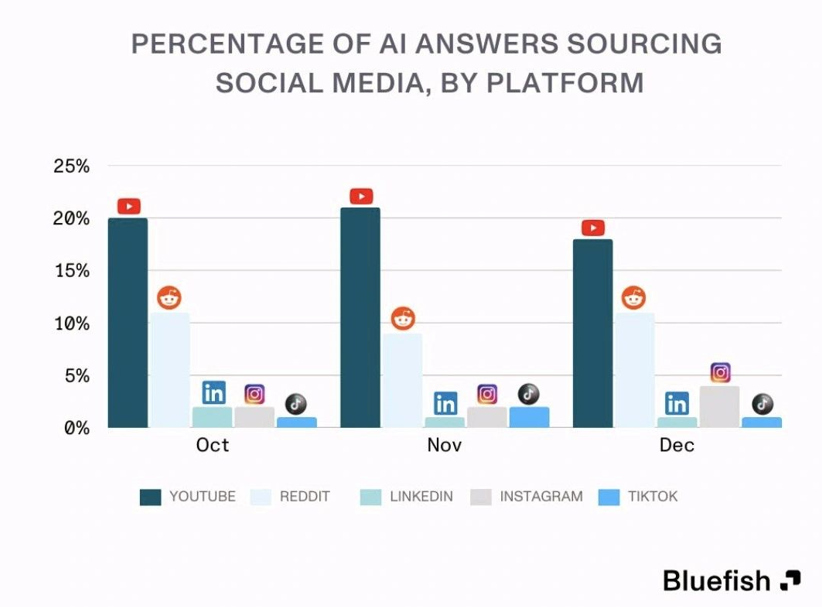
A separate analysis from Adweek confirmed that as of early 2026, YouTube has overtaken Reddit as the most frequently cited social platform in AI-generated responses overall.
The reason this matters is the same reason Reddit’s rise mattered: AI tools including ChatGPT, Google’s AI Overviews, Claude, CoPilot and Perplexity aren’t just surfacing web pages. They’re drawing on content that answers questions clearly, in natural language, from sources users trust.
YouTube does that exceptionally well.
Why Video Has Become Machine Readable
This is the part that often surprises people.
Video content isn’t just visual. Beneath every YouTube video sits a transcript, structured, searchable language that AI systems can interpret in the same way they process written content.
That means a well structured video explaining how a product works, walking through a common problem, or answering a frequently asked question isn’t just useful to the person watching it. It’s providing language models with exactly what they’re looking for: clear, direct, helpful answers in a natural tone.
Think about how often you’ve searched for something and chosen a video over a written article. How to fix a tap. How to use a new piece of software. How to prepare a recipe. The video format answers those questions faster and more clearly than text often can.
AI systems have noticed the same thing.
Transcripts provide structured language models can interpret. Explainers and walkthroughs offer clear, direct answers. And the same content that helps a user understand something can also surface as a trusted explanation across AI-driven discovery.
Video Is a Reusable Asset. That’s the Point.
Here’s where most businesses are leaving value on the table.
A video goes live on YouTube. Views come in. It moves down the feed. And that’s largely where its life ends.
But that’s not how the most effective content strategies treat video.
The same video that explains your product, answers a common objection, or walks a user through a process can:
- Be embedded on relevant service or product pages to strengthen on-page content
- Support FAQ sections with richer, more engaging answers
- Sit closer to conversion on landing pages, in email sequences, alongside calls to action
- Be repurposed into shorter clips for other platforms at different stages of the user journey
- Feed into written content as transcripts, summaries, or supporting material
The opportunity isn’t to make more videos. It’s to make your existing video content work harder across more touchpoints.
Much like a Google Business Profile that’s active but under-optimised, video is one of the most commonly underutilised channels in a business’s content strategy. The asset exists. The work to extract more value from it is often far less than starting from scratch.
What Video Reveals About Your Audience
There’s another dimension to video that often gets overlooked: the insight it generates.
The way people search for, watch, and engage with video content reveals intent very clearly. Query data from YouTube, watch time, drop off points, and the specific questions driving views. All of this tells you something useful about what your audience needs and where they are in their decision making process.
Specifically, video data can highlight:
- Questions people are asking before they search for a solution
- Topics that support decision making but aren’t being addressed elsewhere in your content
- Gaps where video answers something that written content struggles to, particularly how-to and process driven queries
That insight doesn’t have to stay within YouTube. It can inform your wider content strategy, strengthen your search pages, and help you build content that sits closer to where users actually need support.
YouTube SEO: The Foundations Still Matter
None of this happens without the basics being in place.
YouTube is the world’s second largest search engine. That means the same principles that apply to organic search apply here too, just in a video context.
Titles, descriptions, and tags still matter for discoverability. Transcripts and closed captions improve both accessibility and machine readability. Chapters and timestamps help both users and search engines understand the structure of your content. And engagement signals such as watch time, comments, saves influence how YouTube’s algorithm distributes your content.
In his annual letter, YouTube CEO Neal Mohan reinforced that these aren’t optional best practices. They’re essential for visibility. A video without the right foundations is a video that works significantly harder to get found.
Video content is doing more work than most businesses realise.
It’s influencing AI-generated answers. It’s providing language models with structured, natural content they can draw on. It’s generating insight about your audience’s intent. And with the right approach, it’s an asset that can support multiple stages of the journey, from first awareness to final conversion.
The question worth asking isn’t whether video fits your strategy.
It’s whether you’re using it at all, and if you are, whether it’s working as hard as it could be.
Because regardless if you’re yet to make your first piece of video content or you have a library sitting underutilised, the opportunity is the same. Video is one of the few content formats that can support discovery, build trust, and influence decisions all at once.
It’s never too late to start. And if you’ve already started, it’s never too late to make it work harder.
If you’d like to think through how video fits into a wider content or SEO strategy, connect with me on LinkedIn or get in touch directly.